

Skip Bin Permits SA: Who Needs One and How to Apply
Brett Taylor en skip bin permits sa
You need a skip bin permit in South Australia only if the bin sits on public land. Drop it on your own driveway or backyard and no council paperwork is required. Put it on the road, a nature strip, a footpath, or a parking bay, and you need council approval first.
Here’s your one-sentence action: work out whether your bin will touch public land, and if it will, start pulling together a site plan and a certificate of currency before you book delivery.
- Check your council’s website or online property map to confirm whether your placement counts as private or public land.
- If it’s public land, contact your skip bin supplier now and ask whether they can supply a public liability certificate, since most councils will ask for one.
Key Takeaways
A skip bin permit is required in South Australia only when the bin occupies public land, and the application typically needs a site plan plus a $20,000,000 public liability certificate.
| Point | Details |
|---|---|
| Private vs public land | No permit needed on your own driveway or yard; permits are required for roads, footpaths, and nature strips. |
| Certificate of currency | Most councils require public liability insurance coverage of at least $20,000,000 before approving a permit. |
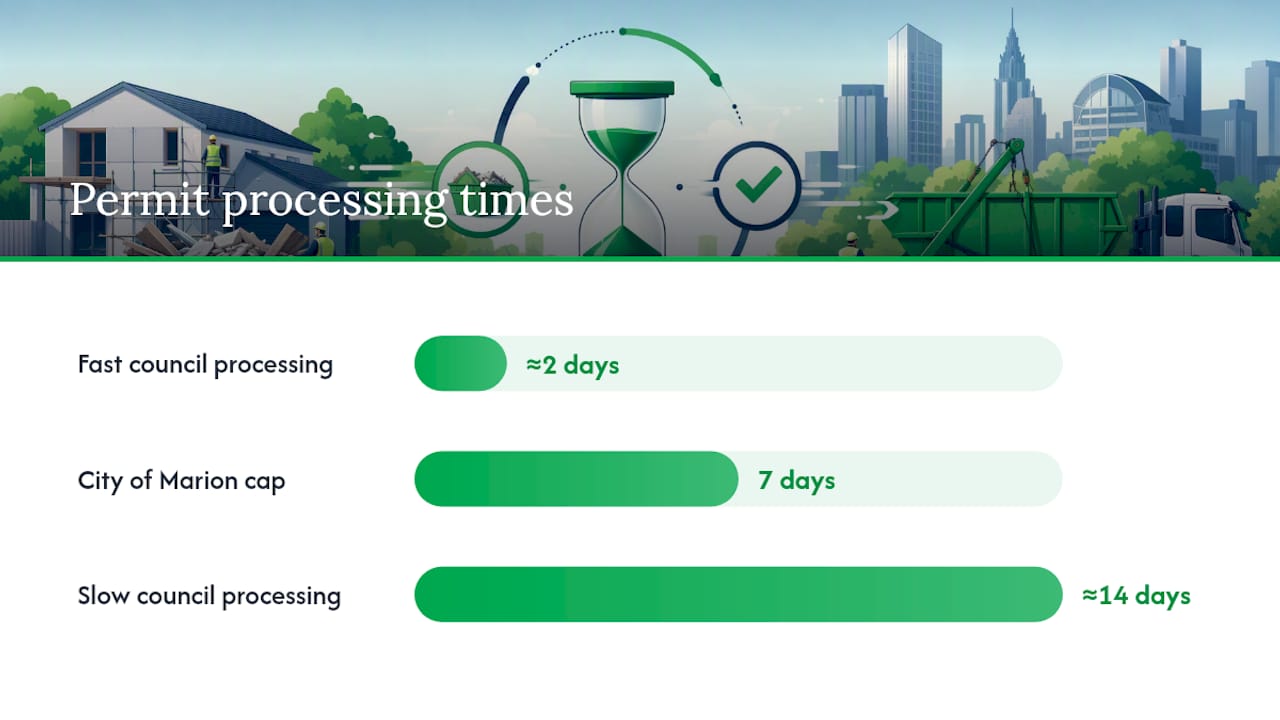
| Apply early | Processing ranges from about 2 to 14 days, and City of Unley recommends applying two weeks ahead. |
| Permits expire | City of Marion caps permits at seven days, and extensions require a new application and fee. |
| Check waste type | Listed or chemical waste may need separate EPA approval even when placement itself is compliant. |
| Book with support | Local Skip Bin Hire matches you with SA suppliers who can help with site plans and certificates of currency. |
Table of Contents
- Do You Need a Skip Bin Permit in South Australia?
- What Councils Typically Require on a Skip Bin Application
- How to Apply for a Skip Bin Permit in South Australia
- What Does a Skip Bin Permit Cost and How Long Does It Last?
- When Do You Need EPA Approval Instead of a Council Permit?
- Your Pre-Delivery Compliance Checklist
- Book a Permit-Ready Skip Bin Through Local Skip Bin Hire
- Frequently Asked Questions
- Sources
Do You Need a Skip Bin Permit in South Australia?
The line is simple: private property doesn’t need council sign off, public land does. A skip parked entirely inside your driveway, on your lawn, or in a private carport falls outside council jurisdiction because it’s your land to use as you see fit.
Step outside that boundary and the rules change fast. Any bin sitting on the road carriageway, a nature strip, a footpath, or a marked on-street parking bay is technically occupying council-controlled land, and that triggers the permit requirement under Sections 221 to 222 of the Local Government Act 1999. It doesn’t matter whether the supplier or the homeowner books the bin. Responsibility for compliance sits with whoever requested the placement.
A few scenarios trip people up regularly:
- A bin parked on your driveway but overhanging the footpath by even half a meter usually still needs a permit, because part of it sits on council land.
- Placing a bin on a neighbor’s property without their agreement is a separate problem entirely and has nothing to do with council rules.
- Bins proposed for arterial roads or state-controlled routes may also need sign off from the Department for Infrastructure and Transport, on top of council approval.
- A small business wanting a bin in a loading zone or commercial parking bay almost always needs a permit, since that space is council or state-managed.
What Councils Typically Require on a Skip Bin Application
Every South Australian council runs its own process, but the paperwork looks remarkably similar across the board. Expect to provide:
- A completed application form (usually available as a PDF or online form on the council’s website)
- A site plan showing the bin’s exact location, dimensions, and distance from intersections or driveways
- Proposed start and end dates for the placement
- Contact details for both the applicant and the skip bin company delivering the bin
The single most consistent requirement across SA councils is a Certificate of Currency for public liability insurance, commonly set at a minimum of $20,000,000 coverage. Councils treat this as non-negotiable because a bin on a public road is a genuine liability risk if a pedestrian or vehicle collides with it.
Depending on where the bin sits, you may also need a basic traffic management plan (bunting, reflective markers, lighting) if it occupies part of the road or footpath, or written consent if it encroaches on a neighboring property.
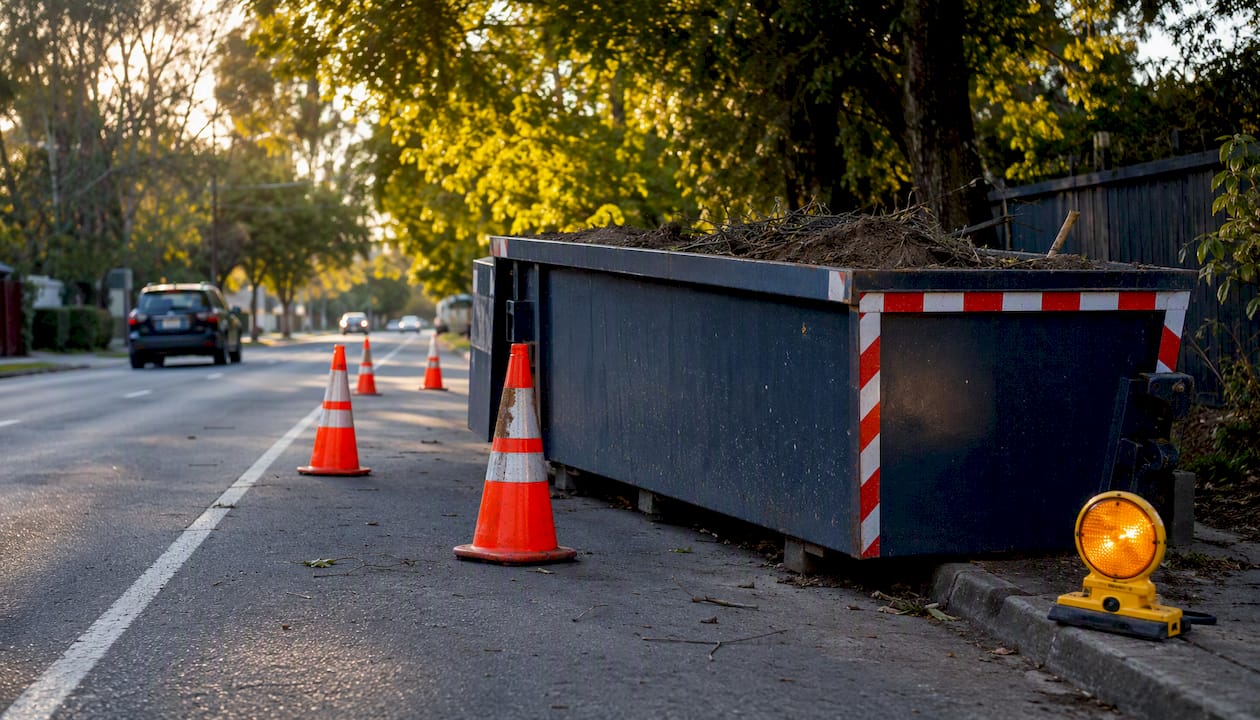
Pro Tip: Ask your skip bin supplier for a scaled site plan template before you start the application. Most suppliers already have one, and it saves you from sketching dimensions from memory and getting rejected on a technicality.
How to Apply for a Skip Bin Permit in South Australia
Applying isn’t complicated once you know the sequence. Follow these steps in order:
- Confirm the exact location. Check whether the bin will sit fully on private land or touch any public land, including footpath overhang.
- Gather your documents. You’ll need the site plan, dates, and a certificate of currency for public liability insurance before you can lodge anything.
- Decide who applies. It can be the property owner, a contractor, or the skip bin company, but the person named on the application carries the compliance responsibility.
- Lodge the form. Most SA councils accept applications online or by email. City of West Torrens runs a straightforward digital form, while City of Marion processes its miniskip and shipping container applications with 10 days’ notice.
- Pay the fee if one applies, and wait for written approval before delivery.
- Comply with conditions once approved, including any time limits or safety requirements listed on the permit.
Timeframes vary by council, so build in a buffer. Adelaide Hills Council needs a minimum of seven days to assess an application, while City of Unley recommends applying at least two weeks ahead of your start date. If your bin needs to sit on an arterial road, factor in extra time for Department for Infrastructure and Transport review too.
What Does a Skip Bin Permit Cost and How Long Does It Last?
Processing times across South Australia range from roughly 2 days to 14 days depending on which council you’re dealing with, so applying the moment you book your bin is always the safer move.
Fees typically stack up in layers: an application fee, then a weekly location charge if the bin stays longer than the initial period, and sometimes a separate traffic management fee for road occupations. Adelaide Hills Council, for example, publishes an application charge for the first week plus a smaller per-week fee after that.
Most permits aren’t indefinite. City of Marion caps permit validity at seven days, and extending beyond that means submitting a fresh application and paying again. Common conditions attached to approval include keeping the bin clear of intersections, adding reflective tape or lighting overnight, and never blocking a footpath entirely.
- Placing a bin on public land without an approved permit risks fines and can force an unscheduled, costly relocation mid job.
- Even a short delay in applying can push your delivery date back a full week if your council needs extra assessment time.
When Do You Need EPA Approval Instead of a Council Permit?
A council permit covers placement. It doesn’t cover what’s inside the bin. Under the Environment Protection Act 1993 (SA), certain waste depots, recycling operations, and listed-waste handling require a separate EPA licence before they can legally operate.
General household waste, garden clippings, and standard renovation debris almost always sit outside this requirement. Problems arise with chemical waste, asbestos, or other listed materials that need specialized handling and disposal pathways.
- Check with your skip bin supplier whether the waste type you’re disposing of falls under any EPA licensing requirement.
- If in doubt, ask the EPA South Australia directly before booking, especially for commercial or construction jobs.
Your Pre-Delivery Compliance Checklist
Before your skip bin arrives, run through this short list so nothing catches you out on delivery day:
- Confirm whether the bin sits on private or public land.
- If public, lodge the council permit application and wait for written approval.
- Get a certificate of currency for public liability insurance, commonly $20,000,000.
- Prepare a scaled site plan showing exact placement and dimensions.
- Arrange traffic management measures if the bin touches the road or footpath.
- Note your permit’s start and end dates so you’re not caught storing a bin past its approval window.
It’s also worth asking your supplier a few direct questions before you commit: Can they provide a template site plan? Do they carry $20,000,000 public liability cover with a certificate you can submit to council? Will they help lodge the permit, or do you need to handle that yourself? And do they operate on arterial roads, which may need separate Department for Infrastructure and Transport approval?
Pro Tip: Request your supplier’s certificate of currency before delivery day, not after, and snap a photo of the bin once it’s placed. That photo is your evidence if a neighbor or council officer ever queries the placement.
A Local Provider’s Take on Permit Mistakes
The most common mistake we see is people assuming a driveway placement covers them, then realizing the bin overhangs the footpath by a few centimeters. It’s an easy fix if you catch it early. Local Skip Bin Hire’s postcode-matching platform connects you with suppliers who’ve handled this exact situation across South Australia for years.
Book a Permit-Ready Skip Bin Through Local Skip Bin Hire
Local Skip Bin Hire takes the guesswork out of matching a bin to your postcode instead of leaving you to call around Adelaide suppliers one by one. Our postcode-matched platform connects you with local suppliers who know exactly which council forms apply in your area and can often provide a certificate of currency and a template site plan on request.
Pricing on our platform is transparent from the start, with delivery, pickup, and removal costs included so there’s no surprise fee once your permit is sorted. If you’re planning a renovation and need a bin sized right for the job, browse skip bin options for Adelaide or compare local prices and book online to see what’s available in your postcode today.
Frequently Asked Questions
Do I need a permit for a skip bin on my own driveway? No. Private property, including driveways and backyards, doesn’t require council approval as long as the bin stays entirely within your boundary.
How long does a skip bin permit take to process in South Australia? It depends on the council. Adelaide Hills Council needs a minimum of seven days, while City of Unley suggests allowing two full weeks.
What insurance do I need for a skip bin permit? Most SA councils require a certificate of currency showing public liability insurance of at least $20,000,000.
Can my skip bin supplier apply for the permit on my behalf? Some suppliers help lodge paperwork, but the applicant, usually the property owner or business, remains responsible for meeting the permit conditions.
What happens if I place a skip bin on public land without a permit? You risk fines and the council may require immediate removal or relocation, which can delay your project and add unexpected cost.
Sources
- Apply for a Skip Bin/Container Permit | City of Unley
- Application for Temporary Permit Placing Skip Bin on Council Land | Adelaide Hills Council
- Skip Bins and Containers Permit Application Form | City of West Torrens
- Circular economy and container deposit licensing guidance | EPA South Australia
Recommended
- A Guide to Permits and Regulations for Skip Bin Placement in Australia – Local Skip Bin Hire
- Skip Bin Hire Adelaide and Perth: A Guide for the Quieter Coasts – Local Skip Bin Hire
- Skip Bin Hire in New South Wales: What You Need to Know – Local Skip Bin Hire
- Skip Bin Hire Sydney: How to Get the Right Bin at the Right Price – Local Skip Bin Hire
What the bin costs before the permit
Council fees stack on top of the hire price, so cost the two lines separately. Live South Australian listings, checked August 2026:
- North Adelaide (5008) — from $243 for a 2m³, $374 for a 4m³, $493 for a 6m³.
- Adelaide-wide averages — $384 for a 4m³ and $502 for a 6m³, with the cheapest 2m³ in the metro area listing at $226 (Adelaide cost page).
- Mount Gambier (5290) — from $270 for a 4m³ and $482 for a 6m³, a reminder that country SA prices on its own curve.
None of that includes the application fee or the weekly location charge, which each council sets itself. For any other postcode, the Adelaide and Surrounds page returns a live local price from the delivery postcode. Prices move, so confirm yours before you tie a delivery date to a permit window.
← Older Post Newer Post →