

Construction Waste Management Plan for Australian Contractors
Brett Taylor construction waste management plan en
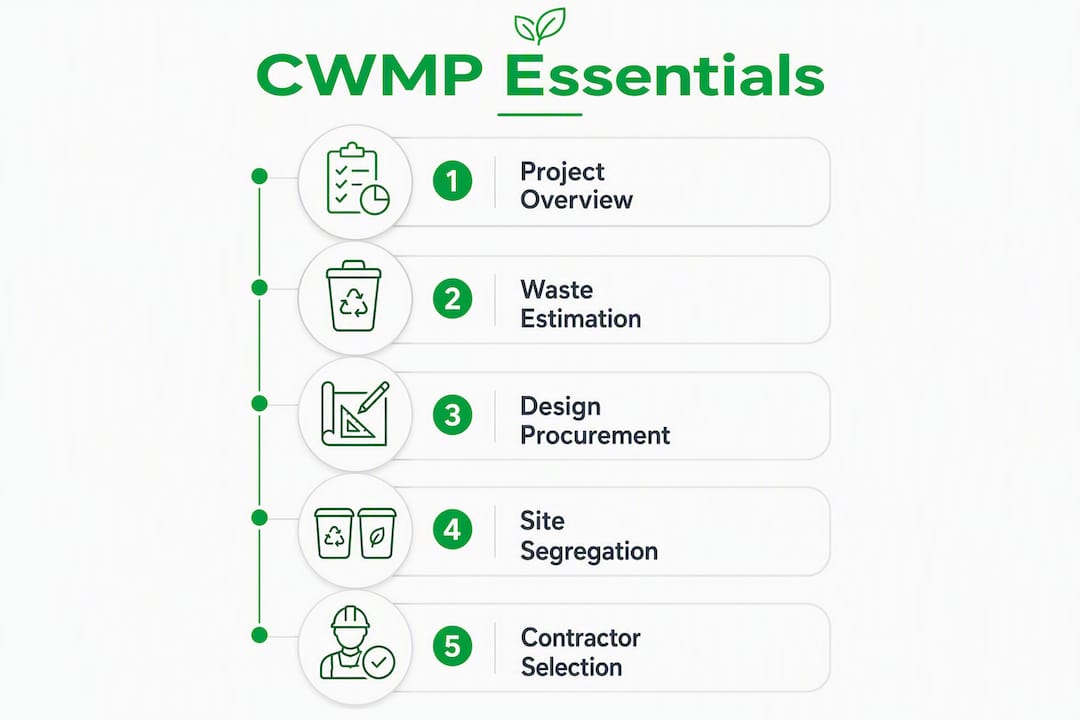
A construction waste management plan (CWMP) is a project-specific, auditable document that records how your site will avoid, divert, and dispose of waste in line with Australia’s national waste hierarchy and a diversion target of 75–80%. Every compliant CWMP must cover seven core elements:
- Estimated waste volumes and streams (by material type)
- Design-stage avoidance measures (procurement rules, cut lists, take-back)
- Nominated qualified waste contractor (ABN/ACN, receival facility approvals)
- Site layout for bin placement and stream segregation
- Responsibility allocation (who signs off at each stage)
- Monitoring and reporting with weight-based evidence (weighbridge tickets, disposal dockets)
- Contingency arrangements for unexpected contamination or waste types
Australia’s construction sector generates a significant share of total national waste, yet about 78% of construction and demolition (C&D) waste is currently diverted from landfill. A well-structured CWMP is what keeps your project on the right side of the 75–80% diversion target and protects final occupancy sign-off.
Table of Contents
- What does a compliant CWMP need to include?
- How do you estimate waste volumes accurately?
- What design and procurement actions cut waste before it starts?
- How should you set up bins and segregation on site?
- How do you select a contractor and build an audit-ready record?
- Your one-page CWMP template and implementation timeline
- Key Takeaways
- Why most CWMPs fail in practice
- Localskipbinhire makes CWMP compliance straightforward
- Authoritative Australian sources for your CWMP
What does a compliant CWMP need to include?
NSW EPA and planning portal guidance sets out the expected sections clearly. Use this table as your document register:
| CWMP Section | What to document | Evidence to keep |
|---|---|---|
| Project overview | Site address, DA number, project type, timeline | Approved DA conditions |
| Waste streams & volumes | Material types, estimated m³ and tonnes | Quantity surveyor estimates |
| Design avoidance strategy | Off-cuts reduction, standardized sizing, take-back | Supplier agreements |
| Reuse and recovery routes | On-site reuse, recycling facilities, receival sites | Receival facility EPLs or development consents |
| Nominated contractor details | ABN/ACN, environmental history, postcode coverage | Contractor license/approval docs |
| Site layout | Bin compound location, truck access, stream labels | Site plan annotated with bin positions |
| Monitoring and reporting | Weekly weight logs, weighbridge tickets, dockets | Signed disposal/recycling receipts |
| Contingency plan | Unexpected contamination, asbestos protocol | Incident response contacts |
The NSW EPA toolkit recommends requiring evidence of lawful reuse, recycling, or disposal before releasing milestone payments, and paying receival facilities directly where possible. That single contract clause does more to protect your audit trail than almost anything else.
For excavation spoil, NSW Chapter 22 guidance recommends in-situ classification and, where clean and usable, targets 100% diversion. Include a spoil-specific sub-section in your CWMP if your project involves significant earthworks.
How do you estimate waste volumes accurately?
Start with materials ordered, apply a waste margin by material type, then convert volume to weight using standard density factors. The table below uses WALGA estimating guidance as a reference:

| Material | Typical waste margin | Density (t/m³) |
|---|---|---|
| Timber framing | 10%–15% | 0.6 |
| Plasterboard | 8%–12% | 0.8 |
| Concrete/masonry | 5%–10% | — |
| Bricks and tiles | 5%–8% | 1.8 |
| Steel off-cuts | 3%–5% | — |
Worked example — 200 m² residential addition:
- Timber ordered: 15 m³ → 12% waste margin → 1.8 m³ waste → ~1.0 tonne
- Plasterboard: 8 m³ → 10% margin → 0.8 m³ waste → ~0.7 tonne
- Concrete off-cuts: 4 m³ → 8% margin → 0.32 m³ waste → ~0.6 tonne
- Total estimated waste: ~2.9 m³ / ~2.3 tonnes
- Target diversion (75–80%): ~1.7 tonnes recycled, ~0.6 tonnes to landfill
Key figure: Australia’s C&D sector currently achieves about 78% diversion from landfill, confirming that the 75–80% target is both realistic and achievable with proper segregation.
Concrete and bricks are dense; a 2m³ heavy-waste skip fills its weight limit long before it fills its volume. Always book by weight capacity for inert streams, not just cubic metres. Reserve 10%–15% contingency tonnage for unexpected off-cuts or subcontractor waste.
What design and procurement actions cut waste before it starts?
The most cost-effective waste disposal strategy is the one that prevents waste from being generated. A systematic review of construction waste literature found that procurement and avoidance measures consistently outperform end-of-pipe recycling for reducing total waste volumes.
Practical actions at the design stage:
- Design for Disassembly: specify mechanical fixings over adhesives, modular panel sizes aligned to standard sheet dimensions, and demountable partition systems
- Standardize dimensions to reduce off-cuts — align framing to 600 mm or 1,200 mm grids wherever possible
- Pre-ordering and cut lists: require suppliers to deliver pre-cut or pre-fabricated elements; include cut-list requirements in trade packages
- Supplier take-back: negotiate packaging return and off-cut buyback with major material suppliers before orders are placed
- Tender prequalification: score suppliers on waste-minimization plans as a non-price criterion, not just cost
Pro Tip: Embed reuse and segregation logistics into your procurement timeline at tender stage. If material take-back and on-site segregation are contractually required in the trade package, subcontractors arrive on site already briefed — you don’t need to chase compliance after mobilization.
How should you set up bins and segregation on site?
Good site logistics reduce contamination, lower tipping fees, and make your monitoring data cleaner. Match bin size to the density and volume of each stream, not to what’s convenient to order.
| Waste stream | Recommended bin size | Placement notes |
|---|---|---|
| Inert (concrete, bricks, tiles) | 9m³ heavy or 7m³ | Near demolition/processing area; weight-limited |
| Timber and mixed C&D | 6m³ or 5m³ | Near framing/carpentry work front |
| Plasterboard (clean, segregated) | 3m³ or 4m³ | Covered; away from wet trades |
| Trade fitout / light mixed | 2m³ mini skip | Near internal trade work fronts |
Locate your waste compound near site access so trucks can maneuver without crossing active work areas. As the project moves through phases, relocate bins to follow the trade activity. Label every bin with the stream name, accepted materials, and a short list of what is not accepted.
For contamination control: run daily visual checks, brief incoming subcontractors on segregation rules at induction, and isolate any bin suspected of asbestos or hazardous contamination immediately. Major-project CWMP examples consistently include a named hazardous-waste protocol and a direct contact for the licensed contractor who handles it.
How do you select a contractor and build an audit-ready record?
Verify every waste contractor against this checklist before signing:
- ABN/ACN confirmed and active
- Receival facility holds a current EPL (Environment Protection Licence) or development consent for the waste types you’re generating
- Postcode-matched coverage with transparent, all-inclusive pricing (delivery, pickup, and tipping included)
- Consignment-note or GPS-tracking options available for hazardous or regulated streams
- Track record on similar project types
Your monitoring system needs to capture, at minimum: daily waste weights by stream, weighbridge ticket numbers, consignment note references, and receival facility receipts. Store these in a dedicated project folder, organized by date and stream. Missing weighbridge tickets or consignment documentation can block final occupancy or permit sign-off — that’s a hard stop, not a paperwork inconvenience.
Link each milestone payment to verified waste evidence. The NSW EPA toolkit specifically recommends this approach to reduce fraud and protect the project record. A simple payment-release checklist works: “Milestone X released when weighbridge receipts for streams A, B, C are filed and verified.”
Your one-page CWMP template and implementation timeline
One-page CWMP fill-in fields:
- Project ID, DA number, site address
- Waste streams and estimated volumes (m³ and tonnes)
- Diversion target (minimum 75%)
- Nominated contractor: name, ABN, receival facility approval reference
- Site layout: annotated plan showing bin compound and stream positions
- Monitoring owner: name and role
- Reporting frequency: weekly weight log, final reconciliation at practical completion
- Contingency plan: unexpected contamination contact and protocol
Implementation timeline:
- Pre-construction (design and tender stage): Add waste-minimization clauses to trade packages; confirm contractor credentials; finalize site layout; set diversion target in CWMP
- Mobilization (week 1): Deliver bins to compound; brief all workers on segregation rules; post stream labels; confirm contractor’s consignment-note process
- Active construction (ongoing): Weekly weight checks; file weighbridge tickets and dockets; adjust bin sizes or swap streams as trade activity changes; flag contamination immediately
- Project close: Final weighbridge reconciliation; compile disposal and recycling dockets; calculate achieved diversion rate; close project file with all evidence
Typical cost categories to budget:
| Cost item | Notes |
|---|---|
| Skip/bin hire | Varies by size and postcode; check transparent pricing to avoid flat-fee surprises |
| Transport and tipping | Included in all-inclusive pricing from reputable suppliers |
| Sorting labour | On-site segregation reduces mixed-load tipping surcharges |
| Contamination uplift | Avoidable with clear signage and daily checks |
| Contingency tonnage | Budget 10%–15% above estimated volumes |
Key Takeaways
A compliant CWMP requires seven documented elements, postcode-matched contractor verification, and weight-based evidence filed at every milestone to protect final sign-off and meet Australia’s 75–80% diversion targets.
| Point | Details |
|---|---|
| Seven mandatory elements | Every CWMP must cover volumes, avoidance, contractor details, site layout, responsibilities, monitoring, and contingency. |
| 75–80% diversion target | Australia’s C&D sector currently achieves about 78% diversion; segregation and contractor selection are the main levers. |
| Weighbridge evidence is non-negotiable | Missing disposal receipts or consignment notes can block occupancy sign-off at project close. |
| Design-stage avoidance saves money | Procurement clauses and cut lists reduce waste before it reaches the bin, cutting tipping costs and contamination risk. |
| Localskipbinhire for compliant booking | Postcode-matched skip hire with transparent all-inclusive pricing supports CWMP recordkeeping and diversion tracking. |
Why most CWMPs fail in practice
The most common reason a CWMP fails is that it gets written once, filed, and never opened again. The plan becomes a compliance checkbox rather than a working site document. Subcontractors who weren’t involved in writing it arrive on site with no idea what the segregation rules are, and by the time the site manager notices contaminated bins, the tipping surcharge is already locked in.
The fix is straightforward but requires deliberate governance. Add CWMP items to the weekly site meeting agenda: review the weight log, check bin labels, confirm the next weighbridge pickup. Make the site manager the named monitoring owner in the document, not a vague “project team.” Require every incoming subcontractor to sign a one-page acknowledgement of the segregation rules before they start work.
Postcode-matched suppliers reduce a specific and underappreciated risk: a national flat-fee provider may route your waste to a receival facility that doesn’t hold the right approvals for your waste stream. That creates a gap in your audit trail that’s very hard to fix after the fact. Local suppliers with transparent, postcode-based pricing are easier to verify and easier to hold accountable.
Localskipbinhire makes CWMP compliance straightforward
Pulling together compliant bin hire for a construction project is faster than most contractors expect, especially when pricing is all-inclusive and suppliers are matched to your postcode. Localskipbinhire connects you with local independent suppliers across Australian metro and regional areas, with bin sizes from 2m³ mini skips for trade fitout waste up to 9m³ bins for heavy demolition streams. Delivery, pickup, and tipping are included in the quoted price, so there are no surprise fees to reconcile against your CWMP budget.
Every booking generates a receipt you can file directly into your project monitoring folder. That’s one less gap in your audit trail. To book bins matched to your site’s postcode and waste streams, check available skips and pricing or go straight to transparent GST-inclusive rates to compare sizes before you commit.
Authoritative Australian sources for your CWMP
Keep these documents in your project file and reference them by name in your CWMP:
| Source | What it covers | Use in your CWMP |
|---|---|---|
| NSW EPA C&D Waste Management Toolkit | Contract provisions, evidence-before-payment, receival site checks | Contractor selection and milestone payment clauses |
| NSW Chapter 22: Waste Management and Resource Use | Waste hierarchy application, spoil classification, contingency planning | Excavation spoil section and contingency protocol |
| NSW Planning Portal CWMP Guidance | Mandatory CWMP elements for DA-approved projects | Document structure and compliance checklist |
| WALGA Construction Waste Guidelines | Waste margin factors, estimating templates, pre-construction planning | Volume and tonnage estimation tables |
| Queensland Waste Reduction and Recycling Plan | National waste hierarchy, diversion targets | Hierarchy statement and diversion target reference |
| Major Projects CWMP Example (NSW) | Operational monitoring, hazardous waste handling, receival site approvals | Hazardous waste protocol and monitoring template |
Documents commonly required as receival-site evidence include: current EPLs or development consents for each receival facility, signed weighbridge tickets for every load, consignment notes for regulated or hazardous streams, and recycling/disposal dockets from the receival facility. Download and save these to a dedicated project folder at the time of each disposal event, not at project close.
Recommended
- Event Waste Management: A 2026 Guide for Australian Organizers – Local Skip Bin Hire
- Renovation Waste Management: The Playbook That Saves Real Money – Local Skip Bin Hire
- Skip Bins for Builders: Running Waste Like a Line Item, Not an Afterth – Local Skip Bin Hire
- The Environmental Impact of Improper Waste Disposal and How to Avoid I – Local Skip Bin Hire
Costing that bin schedule
Budget lines are easier to defend when each row in the table above carries a rate. From our August 2026 capital-city check, lowest live general waste price by size:
- 6m³, the timber and mixed C&D row — from $637 Brisbane, $638 Melbourne, $651 Sydney
- 3m³, the plasterboard row — from $308 Melbourne, $389 Brisbane, $427 Sydney
- 2m³ mini, trade fitout — from $189 Melbourne, $295 Sydney, $310 Perth
Two caveats before these reach a budget line: segregated streams such as clean plasterboard are priced by waste type, and the heavy inert 7m³ and 9m³ are quoted per postcode, so neither comes off this list. The price index shows the city-level spread, the Brisbane and Perth cost pages carry the detail, and the live checker confirms rates the day you lock the trade package.
← Older Post Newer Post →